TL;DR: Amazon's Seller Central table asks for at least 900 days of remaining shelf life when beauty and personal care units check in to FBA. Subtract 900 from total shelf life to get the days available before check-in: about 195 for a 36-month product. A 24-month product cannot qualify. Confirm the current number in your account.
Last reviewed: October 2026.
What are Amazon's FBA expiration date requirements for beauty products?
Amazon treats any product that loses effectiveness over time as expiration-dated, even when nothing is printed on the box. Its staff post on the topic says items must arrive with enough shelf life for the product to be used up, plus an extra 90 days. Beauty and personal care sit under a stricter category rule: 900 days.
Three layers apply to a typical skincare, haircare or cosmetics SKU:
- Expirable flag. You mark the ASIN as expirable and tell Amazon how long the product keeps in the building.
- Remaining shelf life at check-in. Each unit must have enough days left on the day the fulfillment center receives it.
- Labeling. The expiration date has to be readable, in the right format, and on both the unit and the carton.
Fail any one and units can be delayed, received as expired, or marked unsellable. That is inventory you paid to make, ship and store, so it belongs in your margin model, not just your compliance checklist. If your numbers already look thin, read the Amazon profit paradox first.
What is the 900-day rule for personal care and beauty on FBA?
The 900-day rule is the minimum remaining shelf life Amazon lists for personal care and beauty products at the moment of check-in. Sellers quoting Amazon's expiration-date table in the Seller Forums describe the row as "personal care and beauty products (shampoos, soaps, lotions, makeup, fragrances): 900 days." In the same table they quote 730 days for supplements and 540 days for candy.
The Seller Central help page itself sits behind a login, so check the live table in your own account before you commit to a production run. Amazon changes these rules, so read the current figure rather than trusting any blog post, including this one.
Two points make the rule easy to misread:
- It measures remaining life, not total life. A product with 36 months of shelf life has 1,095 days on the day it is made, and it loses a day every day after that.
- It applies at check-in. It is not a promise that units can sit in FBA until 900 days before expiry. After check-in, other removal and disposal rules apply.
Why do Amazon's rules seem to contradict each other?
Because the public sources do not agree on one number, and sellers have noticed. Amazon staff have told sellers that every product needs time to be consumed in full plus 90 days. The category table then asks 900 days for beauty. And in one seller's report, the shipment creation workflow accepted units with about 105 days left, while the same units were later tagged expired under the 900-day row.
In the Seller Forums reports, the category row is the one that caused the problems. Treat the shipment workflow as a convenience check, not as approval. Plan to the stricter number, and ask Seller Support for the rule in writing if you are close to the line.
| Source | What it says | How to treat it |
|---|---|---|
| Amazon staff post on FBA and expiration dates | Items need time to be consumed or used, plus 90 days | General floor for every expirable product |
| Category table quoted in Seller Forums | 900 days for personal care and beauty | The number to plan production around |
| Shipment creation check, as reported by one seller | About 105 days | Do not rely on it to prove compliance |
How much shelf life does my beauty product need to have?
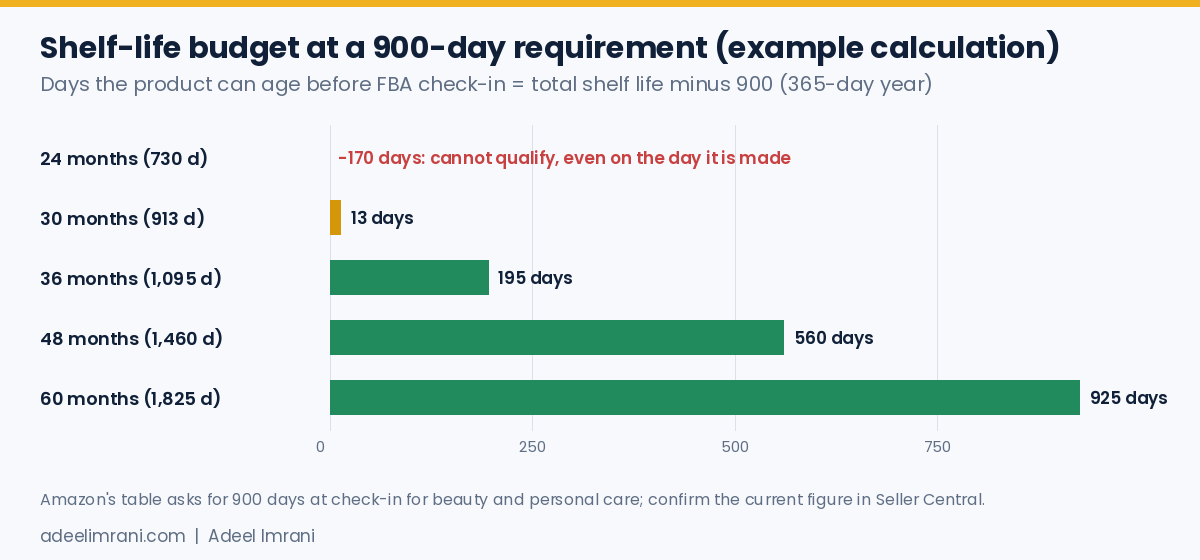
You need more than 900 days in total, and you need to deliver it fast. The budget is simple: total shelf life minus 900 days is the number of days the product can age before it reaches the fulfillment center. The table uses a 365-day year, so it is an example calculation, not an Amazon figure.
| Total shelf life | Days | Days left to reach check-in | What it means |
|---|---|---|---|
| 24 months | 730 | −170 | Cannot qualify, even on the day it is made |
| 30 months | 913 | 13 | Technically possible, practically unworkable |
| 36 months | 1,095 | 195 | About 6.4 months from production to check-in |
| 48 months | 1,460 | 560 | About 18.4 months of runway |
| 60 months | 1,825 | 925 | About 30.4 months of runway |
Check the arithmetic on the 36-month row: 36 × 365 ÷ 12 = 1,095 days, and 1,095 − 900 = 195 days. For a real calendar, the calculator below uses actual month lengths and leap days, so a 36-month product made on 1 March 2026 has 1,096 days of life.
Shelf-life budget calculator: can this batch ship to FBA?
Enter the total shelf life and, if you have them, a manufacture date and a planned check-in date. The tool tells you the latest date a batch can be received and whether your planned date passes. The requirement field defaults to 900 days; change it if Seller Central shows a different number.
Results appear here. Without JavaScript, use the example table above.
Worked example: a 36-month shampoo made on 1 March 2026
- Expiration date: 1 March 2029 (36 calendar months later).
- Total shelf life: 1,096 days, because 2028 is a leap year.
- Latest check-in date: 1 March 2029 minus 900 days is 13 September 2026.
- Production-to-dock window: 196 days.
If that shampoo is received on 1 December 2026, only 821 days remain. That is 79 days short. The batch was fine for any retailer that accepts shorter dates, and still wrong for this rule. Example numbers only; your own dates and Amazon's current requirement decide the outcome.
Does the FDA require expiration dates on cosmetics?
No. The FDA states that no U.S. law requires cosmetics to carry an expiration date, and it does not set a shelf-life rule for them. Manufacturers decide how long a product stays safe and stable, and many use a "period after opening" symbol on the label to show how long a jar stays good once it is opened.
That matters because Amazon's rule comes from marketplace policy, not federal cosmetic law. Your factory's stability data is the real source of your shelf life number. Ask for it in writing, along with the test conditions behind it.
There is one exception worth knowing. Products that are also drugs, such as sunscreens or acne treatments, are regulated as over-the-counter drugs. Drug regulations require expiration dating, so those SKUs need an expiry printed. See the eCFR text of 21 CFR 211.137 and confirm your product's status with your regulatory contact.
How do I set the expirable fields in Seller Central?
Amazon's listing flow asks whether the product is expirable and which type applies. The staff post describes options such as a printed production date, or a product that loses effectiveness over time but has no exact date. It also asks for a "fulfillment center shelf life" between 0 and 1,825 days: how long the product can stay in the building without losing effectiveness.
- Mark the ASIN as expirable on the listing's vital info tab or in the file upload.
- Choose the expiration type that matches what is printed on your package.
- Enter the fulfillment center shelf life from your stability data. A value of 1,825 days is the ceiling of the field, so a five-year product fits.
- Recheck bundles. Amazon suggests using the soonest expiration date among the items in a bundle.
How must expiration dates be labeled for FBA?
Amazon's labeling rules are mechanical, and mistakes here cause receiving delays even when your shelf life is fine. Based on the staff post and Amazon's published prep guidance as summarized by a prep-software help center, the checklist is:
- Use MM-DD-YYYY or MM-YYYY. Cover any other format with a corrected sticker.
- Print the date in 36-point or larger type on the master carton, and on each unit or retail display unit.
- Cover a printed manufacture date, which can cause units to be received as expired.
- Do not mix different dates for the same ASIN in a single box. Keep one expiration date per ASIN per carton.
- Use FBA labels on expiration-dated units. They cannot be commingled.
- If a jar or bottle sits inside extra packaging, make the date visible without opening it.
Lot numbers alone are not enough. If your factory prints only a lot code, you need a date sticker, and you should budget for it.
What happens when units get too close to their expiration date?
Units that are tagged expired or that cannot be confirmed are marked unsellable, and you pay to remove or dispose of them. Amazon's staff post says inventory past its date, or with a date that cannot be confirmed, is marked unsellable. Several sellers in the forums report units flagged months before their printed date because of the category rule.
A prep-software guide dated September 2024 also states that units within 50 days of expiry are removed for disposal. That page describes older rules (a 90-day check-in floor), so treat the 50-day figure as indicative and verify the current removal window in your account.
The cost shows up as removal fees, lost sales and a worse inventory performance picture. Add an "expiry loss" line to your unit economics, and keep it in the same sheet as your breakeven ACoS inputs. Money lost on dead stock is money your ad budget cannot recover.
What if my product's shelf life is under 30 months?
You have four realistic options, and none of them is "ship it and hope."
- Extend the stated shelf life with real data. Ask the manufacturer whether stability testing supports a longer date. Never change a printed date without that evidence.
- Reformulate or repackage. Formulation or packaging changes can sometimes extend stability, but only testing can show it, and it costs money.
- Use another fulfillment route. Merchant-fulfilled orders and other channels follow their own rules, so check each one before you rely on it.
- Request clarification. If your category was misread, ask Seller Support which row applies to your product and keep the answer.
If you sell on several channels, the shelf-life decision affects the whole mix. I walk through how fees and compliance cost change the channel math in the beauty profit margin waterfall.
How should I plan production around the 900-day rule?
- Get the total shelf life in writing, with the stability study behind it.
- Compute your window with the calculator: total days minus the requirement.
- Back-schedule. Subtract the time for filling, QC release, freight, customs and prep from that window. Whatever is left is your float.
- Size batches to the window, not to the factory's minimum run, when the float is under three months.
- Label dates before shipping, and photograph the carton label for your records.
- Recheck Seller Central each quarter. Policy changes, and your supplier's dates should change with it.
A small window turns inventory planning into a cash-flow problem. The same rule that protects customers can quietly cap how much you can order, which is why I treat compliance cost as part of margin, not as paperwork. If you want a second set of eyes on your SKUs, book an audit, or see the case studies and the hair care brand turnaround for how I look at the numbers.
Key takeaways
- Beauty and personal care units need roughly 900 days of remaining shelf life at FBA check-in, per the table sellers quote from Seller Central. Verify the live figure.
- Maximum age at check-in is total shelf life minus 900 days. A 36-month product has about 195 days.
- Products under about 30 months of total life cannot meet a 900-day rule.
- The FDA does not require cosmetic expiration dates, so your shelf life comes from stability data. Sunscreens and acne products are the exception.
- Label dates as MM-DD-YYYY or MM-YYYY in 36-point type, on the carton and the unit.
- Do not treat the shipment workflow's pass as proof of compliance.
- Budget for expiry losses in your unit economics.
Frequently asked questions
What is the 900-day rule on Amazon FBA?
It is the minimum remaining shelf life Amazon lists for personal care and beauty products when they are received at a fulfillment center. A product with less than 900 days left at check-in can be refused or later tagged expired. The figure comes from Amazon's category table, so confirm the current value in Seller Central before you manufacture.
Do all beauty products need an expiration date on Amazon?
Amazon treats any product that loses effectiveness over time as expiration-dated, even without a printed date. For cosmetics without a printed date, you can use the shelf-life option and enter a fulfillment center shelf life. Products that are also drugs, such as SPF or acne treatments, must carry an expiration date under FDA drug rules.
How many months of shelf life do I need for the 900-day rule?
You need more than 30 months in total, because 900 days is about 29.6 months. In practice you want 36 months or more. At 36 months you have roughly 195 days from manufacture to check-in. At 48 months you have about 560 days, which is far easier to manage.
Does the FDA require expiration dates on cosmetics?
No. FDA says no U.S. law requires cosmetics to be labeled with an expiration date, and it leaves shelf-life decisions to manufacturers. The exception is any product that is also an over-the-counter drug, such as sunscreen, which falls under drug rules that require expiration dating. Amazon's rule is a marketplace policy.
What date format does Amazon require on expiration labels?
Amazon's guidance calls for MM-DD-YYYY or MM-YYYY, printed at 36-point font or larger on the master carton and on each unit. If your factory prints another format, cover it with a corrected sticker. A printed manufacture date should also be covered, and lot numbers alone do not count as an expiration date.
What happens to FBA units that are too close to expiring?
Units past their date, or with a date Amazon cannot confirm, are marked unsellable, and you pay for removal or disposal. Sellers also report units tagged expired before the printed date under the category rule. A third-party guide mentions disposal within 50 days of expiry; verify the current window in your account.
Can I ship beauty products with less than 900 days to FBA?
Not reliably. One seller reported that shipment creation accepted units with about 105 days left, and the same units were later flagged under the 900-day row. Treat the stricter number as the rule, and ask Seller Support for written confirmation if your product is close to the line or in a borderline category.
Sources
Amazon's Seller Central help pages require a login, so Amazon policy statements below are cited from Amazon staff posts and seller quotations in the Seller Forums. Check each against your own Seller Central account.
- Amazon Seller Forums: FBA and Expiration Dates, what you need to know
- Amazon Seller Forums: Updated Expiration Date Policy (900 days quoted)
- Amazon Seller Forums: Expiration-dated cosmetics, with an Amazon staff reply
- Amazon Seller Forums: Units tagged expired before the printed date
- ScanPower Help Center: Amazon product expiration guidelines (third party, 2024)
- FDA: Shelf life and expiration dating for cosmetics
- eCFR: 21 CFR 211.137, Expiration dating
Want your inventory rules checked against your margins?
Expiry rules, fees and ad spend interact. If you would like me to review your SKUs and show where cost is leaking, book an audit. You can also read about my approach first. Sibling guide: is nail polish hazmat on Amazon?