TL;DR: Breakeven ACoS is profit before ad spend divided by price, not net margin. Target ACoS is breakeven minus the profit you want to keep. In the example, a $30 product with $10.50 of pre-ad profit has a 35% breakeven and a 20% target. TACoS divides ad spend by total sales to show whether ads build organic demand.
Last reviewed: October 2026.
Breakeven ACoS formula (Amazon)
Break-even ACoS = (selling price − all non-ad costs per unit) ÷ selling price × 100.
Non-ad costs are landed product cost, Amazon referral fee, FBA fulfillment fee, storage, returns and any other per-unit cost. Break-even ACoS equals your profit margin before advertising, not your net margin. Below it, ad-driven sales make money; above it, they lose money. Example: $10.50 of pre-ad profit on a $30 price is a 35% break-even ACoS and a 2.86 break-even ROAS.
What are ACoS, ROAS and TACoS?
ACoS is ad spend divided by ad-attributed sales. ROAS is its inverse. TACoS divides ad spend by total sales, advertised and organic together. Amazon's own guide defines ACOS as ad spend divided by ad revenue, and gives the example of $50 spent to earn $100, which is a 50% ACOS and a ROAS of 2.
| Metric | Formula | Question it answers |
|---|---|---|
| ACoS | Ad spend ÷ ad sales | Is this campaign efficient? |
| ROAS | Ad sales ÷ ad spend (1 ÷ ACoS) | How many sales per ad dollar? |
| TACoS | Ad spend ÷ total sales | Are ads building the whole business? |
None of them tells you whether you made money. For that you need your costs, which is where breakeven comes in.
What is breakeven ACoS, and how do I calculate it?
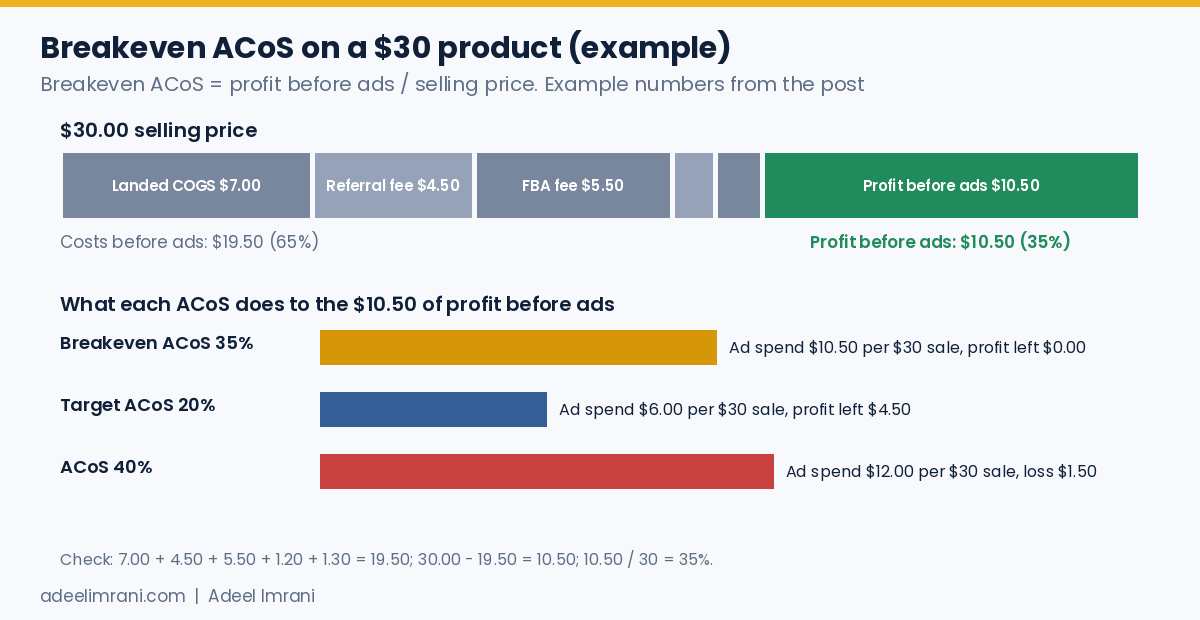
Breakeven ACoS is the share of each advertised sale you can spend on ads before you lose money on that sale. The formula is profit before ads divided by selling price. If a $30 item earns $10.50 before advertising, you can spend up to 35% of its price on ads and still break even on advertised units.
Amazon's ACOS guide says break-even ACOS is linked to profit margin and that ACOS must stay below it. The more exact version is below. Margin after ads is what is left once ad spend is out, so it cannot be the starting point.
- Start with the selling price.
- Subtract landed product cost (COGS), including freight and duties.
- Subtract the referral fee. For Beauty, Health and Personal Care, Amazon's pricing page lists 8% on items priced at $10 or less and 15% above $10, with a $0.30 minimum per item.
- Subtract the fulfillment fee from your FBA fee preview.
- Subtract returns, damage and write-off reserves.
- Subtract any other per-unit cost, such as inbound shipping, storage, prep or compliance.
- The remainder is profit before ads. Divide it by price.
Worked example: a $30 beauty product (all inputs are examples)
| Line | Per unit | Share of price |
|---|---|---|
| Selling price | $30.00 | 100% |
| Landed COGS | $7.00 | 23.3% |
| Referral fee (15%) | $4.50 | 15.0% |
| FBA fulfillment fee (example) | $5.50 | 18.3% |
| Returns and damage reserve (4%) | $1.20 | 4.0% |
| Other per-unit costs (example) | $1.30 | 4.3% |
| Profit before ads | $10.50 | 35.0% |
Check: 7.00 + 4.50 + 5.50 + 1.20 + 1.30 = 19.50, and 30.00 − 19.50 = 10.50. Then 10.50 ÷ 30.00 = 35.0%. Breakeven ACoS is 35%. A campaign at 35% ACoS earns nothing on those sales. At 40% it loses $1.50 per unit, because 40% of $30 is $12.00 against $10.50 of pre-ad profit.
Why is breakeven ACoS not the same as net margin?
Net margin is calculated after ad spend, so using it as your breakeven double counts advertising. Breakeven starts from profit before ads. Many sellers confuse the two and set a target that is either too loose or too tight.
The distinction matters most when fees change. Referral fees, FBA fees, returns and storage all sit above the ad line, so each one lowers breakeven one-for-one. A fee change on your side moves your bidding ceiling even if the ad dashboard looks identical.
What is target ACoS?
Target ACoS is breakeven ACoS minus the profit you want to keep on advertised sales. Amazon's guide tells sellers to find break-even first and then decide whether the goal is growth, profit or both. Your target is that decision expressed as a number.
In the example, keeping 15 points of price means a 20% target (35% − 15%). On a $30 order that is $6.00 of ad spend and $4.50 of profit left. Use a lower target for products you want to be profitable immediately, and a higher one, still below breakeven, for a launch where you are buying rank. Never set a standing target above breakeven unless you have a deliberate, time-boxed reason.
What maximum CPC can I bid?
Maximum CPC equals target ACoS × price × conversion rate. Ad cost per order is CPC divided by conversion rate, so the equation follows from ACoS = (CPC ÷ conversion rate) ÷ price. Conversion rate is the part most sellers guess, so use your own data.
| Conversion rate | Max CPC at 20% target | Max CPC at 35% breakeven |
|---|---|---|
| 8% | $0.48 | $0.84 |
| 10% | $0.60 | $1.05 |
| 12% | $0.72 | $1.26 |
Arithmetic for the 10% row: 0.20 × $30 × 0.10 = $0.60, and 0.35 × $30 × 0.10 = $1.05. A keyword whose clicks cost $0.90 at a 10% conversion rate runs at an ACoS of ($0.90 ÷ 0.10) ÷ $30 = 30%. That is above the 20% target and below the 35% breakeven.
ACoS and TACoS calculator for your own numbers
The defaults reproduce the example above. Replace them with your own price, fees and costs. The ad fields at the bottom are optional. If you fill them in, the tool also reports ACoS, ROAS and TACoS, and estimates profit after ads.
Results appear here. Without JavaScript, use the worked tables above.
With the defaults the tool shows an ACoS of 30%, a ROAS of 3.33, a TACoS of 9% and an estimated $26,000 of profit after ads. It assumes every sale, ad-driven or organic, earns the same 35% before ads, which is a simplification.
If you would rather apply ceilings like these across a whole account than one SKU at a time, BidVentor's Amazon PPC tool is the software I built for Amazon ad management. Disclosure: I'm the founder of BidVentor.
Which costs do sellers leave out of break-even ACoS?
The formula is simple; the cost list is where most calculations go wrong. A break-even ACoS built only from price, product cost, referral fee and FBA fee overstates how much you can spend on ads. Before you trust the number, check that your per-unit costs include:
- Freight, duties and tariffs, so product cost is landed cost, not factory cost.
- FBA inbound placement and any prep or labeling charges.
- Monthly storage, and aged inventory surcharges on slow sellers.
- Returns and refunds, including units that come back unsellable. For beauty, opened products usually cannot be resold.
- Coupons, deals and promotion fees.
- Removal and disposal of expired or unsellable stock. Shelf life matters here; see the FBA expiration date requirements.
- Surcharges Amazon adds during the year, such as fuel and logistics or holiday peak fees.
Each missing cost raises your apparent break-even ACoS by the same share of price. A $0.90 returns cost left out of a $30 product adds 3 points to the break-even figure, which is 3 points of ad spend that is really a loss. Recalculate break-even per ASIN, because products with different margins cannot share one target.
What is break-even ROAS on Amazon?
Break-even ROAS is the same threshold written the other way round: break-even ROAS = 1 ÷ break-even ACoS (as a decimal), or selling price ÷ profit before ads. With a 35% break-even ACoS, break-even ROAS is 1 ÷ 0.35 = 2.86, so each $1 of ad spend must bring at least $2.86 of ad-attributed sales. A 20% target ACoS is the same as a target ROAS of 5.0.
Amazon Ads makes the same point in its own guide: a high ROAS can still lose money when margin is low, so compare campaign ROAS with your break-even ROAS before calling a campaign good. Use whichever metric your team reads, but derive both from the same margin.
What is TACoS, and why does it matter?
TACoS shows how much of total revenue you spend on ads, so it reveals whether advertising is feeding the whole business or replacing demand. Falling TACoS with growing revenue usually means ads are building organic rank. Rising TACoS with flat revenue means spend is substituting for demand.
A made-up pair of months shows how ACoS can mislead. Both months use the 35% pre-ad profit rate from the example.
| Metric | Month A | Month B |
|---|---|---|
| Total sales | $100,000 | $125,000 |
| Ad sales | $30,000 | $80,000 |
| Ad spend | $9,000 | $22,400 |
| ACoS | 30% | 28% |
| TACoS | 9.0% | 17.9% |
| Profit before ads (35%) | $35,000 | $43,750 |
| Profit after ads | $26,000 | $21,350 |
Sales rose 25%, ACoS improved from 30% to 28%, and ROAS rose from 3.33 to 3.57. Profit still fell by about 17.9%, from $26,000 to $21,350. Organic sales dropped from $70,000 to $45,000 while ads took over more of the revenue. Only TACoS (9.0% to 17.9%) and the profit line showed it.
This is the same pattern I describe in the Amazon profit paradox: growth that costs more than it returns. Watch ACoS by campaign and TACoS by account.
What is a good TACoS for a beauty brand?
There is no single good TACoS, and published benchmarks disagree. Two agency-published guides give different launch ranges: one says 18% to 25% is normal at launch, the other says 25% to 40%. Both say 10% to 15% is typical for an established account, and one puts mature beauty at 14% to 20%.
These are vendor benchmarks, not Amazon data, and the methods are not independently audited. Use them as a sanity band, then anchor to your own breakeven. If your pre-ad margin is 35%, a TACoS of 20% leaves very little for overhead.
| Stage or category | Range cited | Source type |
|---|---|---|
| Established account | 10% to 15% | Two agency guides |
| Launch phase | 18% to 25% (one guide) or 25% to 40% (the other) | Two agency guides |
| Mature beauty and personal care | 14% to 20% | One agency guide |
When does a "good" ACoS still lose money?
When your costs move and your target does not. A 30% ACoS looks fine against a 35% breakeven. If returns double and you add an expiry or compliance reserve, the same campaign can lose money without any change in the ad console.
| Scenario | Profit before ads | Breakeven ACoS |
|---|---|---|
| Base case | $10.50 | 35.0% |
| Returns reserve rises from 4% to 8% (+$1.20) | $9.30 | 31.0% |
| Plus a $0.75 expiry or compliance reserve | $8.55 | 28.5% |
At a 30% ACoS the campaign spends $9.00 per order against $8.55 of pre-ad profit, a loss of $0.45 per order. Shelf-life and hazmat rules feed these lines directly, so read the FBA expiration date guide and the beauty hazmat guide when you set that reserve.
How do I use breakeven and target ACoS day to day?
- Calculate breakeven per SKU, not per brand. Pack sizes and fees differ.
- Set a target for each SKU by lifecycle: launch, growth or mature.
- Convert it into a CPC ceiling from your own conversion rate.
- Review weekly: cut or lower bids where ACoS runs above target for a meaningful number of clicks.
- Track TACoS monthly and read the trend, not one reading.
- Recompute breakeven whenever fees, price, coupons or returns change.
The Hair Care brand in our hair care brand turnaround moved its ACoS from 25.65% to 19.78%. A number like that only means something against that brand's own breakeven, which is why I start every engagement with the unit economics, not the dashboard. See the case studies for more.
Channels differ, too. A fee structure that works on Amazon may not on TikTok Shop or Walmart, which I cover in the beauty marketplace fee comparison and in the profit margin waterfall. If you want help fixing the structure, not just the bids, look at the partnership option.
Key takeaways
- Breakeven ACoS = profit before ads ÷ price. It is not net margin.
- Target ACoS = breakeven ACoS − the profit you want to keep.
- Maximum CPC = target ACoS × price × conversion rate.
- In the example, 35% breakeven, 20% target, $0.60 max CPC at a 10% conversion rate.
- TACoS tracks total sales, so it exposes ad-dependent growth that ACoS hides.
- TACoS benchmarks come from vendors and disagree, so anchor to your own margin.
- Recompute breakeven whenever fees, returns or reserves change.
Frequently asked questions
What is a good ACoS for Amazon?
A good ACoS is one below your breakeven ACoS and, ideally, below your target ACoS. Amazon says there is no definitive good number because it depends on industry and margins. Calculate profit before ads divided by price, subtract the profit you want to keep, and use that result as your ceiling.
How do you calculate breakeven ACoS?
Divide your profit before ad spend by your selling price. Profit before ads is price minus product cost, referral fee, fulfillment fee, returns reserve and other per-unit costs. In the example, $10.50 of pre-ad profit on a $30 price gives a breakeven ACoS of 35%.
What is the difference between ACoS and TACoS?
ACoS divides ad spend by sales attributed to ads. TACoS divides ad spend by total sales, including organic. ACoS judges campaigns, while TACoS judges the account. A falling TACoS with rising revenue suggests advertising is building organic demand, and a rising TACoS with flat revenue suggests spend is replacing it.
What is the formula for target ACoS?
Target ACoS equals breakeven ACoS minus the margin you want to keep on advertised sales. If breakeven is 35% and you want to keep 15 points of the selling price, the target is 20%. On a $30 item that means no more than $6.00 of ad spend per order.
How do I find my maximum CPC bid?
Multiply target ACoS by selling price and conversion rate. With a 20% target, a $30 price and a 10% conversion rate, the maximum is 0.20 × 30 × 0.10 = $0.60. Use your own conversion rate by keyword or ad group, because guessing it breaks the calculation.
What is ROAS and how does it relate to ACoS?
ROAS is ad sales divided by ad spend, so it is the inverse of ACoS. A 25% ACoS equals a ROAS of 4, and a 50% ACoS equals a ROAS of 2. They carry the same information in different forms, and neither tells you profit unless compared with breakeven.
What TACoS should a new beauty product aim for?
Published benchmarks vary, with launch ranges quoted from 18% to 25% in one guide and 25% to 40% in another. Treat them as vendor estimates, not Amazon data. Set a ceiling from your own breakeven and watch whether TACoS falls as organic sales and rank build.
What is break-even ROAS on Amazon?
Break-even ROAS is 1 divided by break-even ACoS, or selling price divided by profit before ads. A product with a 35% break-even ACoS has a break-even ROAS of 2.86: every $1 of ad spend must bring at least $2.86 of ad sales. Below that ROAS, advertised sales lose money.
Is break-even ACoS the same as profit margin?
It equals your profit margin before advertising, not your net margin. Take price minus product cost, Amazon fees, storage, returns and other per-unit costs, then divide by price. Using net margin, which already has ad spend and overhead taken out, understates how much you can spend on ads.
Sources
Fee figures, ACoS definitions and benchmarks come from the pages below. Benchmarks from agencies and tool vendors are marked as such and are not Amazon data. All example numbers in this article are illustrative, so check your own fee preview in Seller Central.
- Amazon Ads: What is advertising cost of sales (ACOS)?
- Sell on Amazon: Pricing and referral fees
- SellMath: Break-even ACoS calculator and formulas (tool vendor)
- SellerForge: ACoS calculator and break-even formula (tool vendor)
- eBrands: Setting ACoS and TACoS targets (agency)
- EightX: Average TACoS benchmarks (agency)
- Amazon Ads: Practical calculations (break-even ROAS)
Want your ad targets built from your real margins?
If you would like a second opinion on your breakeven numbers, book an audit. You can also read more about me first.