Short answer (TL;DR)
In an example $30 beauty order, net margin per order comes out at about 36% on Walmart (WFS), 31% on Amazon FBA, 30% on Shopify and 26% on TikTok Shop with a 15% creator commission. Ad spend, creator commissions and fulfillment move the ranking more than headline referral fees do. Use the calculator below with your own numbers.
Last reviewed: October 2026. Fee pages were checked on October 27, 2026. Fees change often, so confirm every rate in your own Seller Center, Seller Central or Shopify admin before you act on it.
TikTok Shop profit margin, in one line: net margin = (price − product cost − TikTok referral fee − creator commission − samples − ads − returns − fulfillment) ÷ price. In the example $30 beauty order below, that is 25.7% on TikTok Shop against 31.2% on Amazon FBA, before overhead.
If you sell beauty, hair or salon products, the question is rarely "which marketplace is cheapest?"
If you sell beauty, hair or salon products, the question is rarely "which marketplace is cheapest?" It is "how much of each order do I keep after every cost that order triggers?" A 6% referral fee looks tiny next to Amazon's 15%, until you add creator commissions, free samples, returns of opened products and the ads needed to get the order in the first place.
This guide puts one example product through four channels (Amazon FBA, Walmart Marketplace with WFS, TikTok Shop and Shopify), shows the arithmetic, and gives you an editable calculator. Numbers marked "example" are illustrative assumptions, not benchmarks or anyone's actual results. Fees come from each platform's own published pages, listed under Sources.
Which channel keeps the most margin per order for beauty brands?
For the example product below (a $30 item, $7.50 landed cost, light enough for the smallest fulfillment tier), the results are:
| Channel | Net profit per order | Net margin | Margin before ads |
|---|---|---|---|
| Amazon FBA | $9.36 | 31.2% | 43.2% |
| Walmart Marketplace + WFS | $10.85 | 36.2% | 44.2% |
| TikTok Shop (15% creator commission) | $7.70 | 25.7% | 30.7% |
| Shopify (own store, 3PL) | $8.85 | 29.5% | 49.5% |
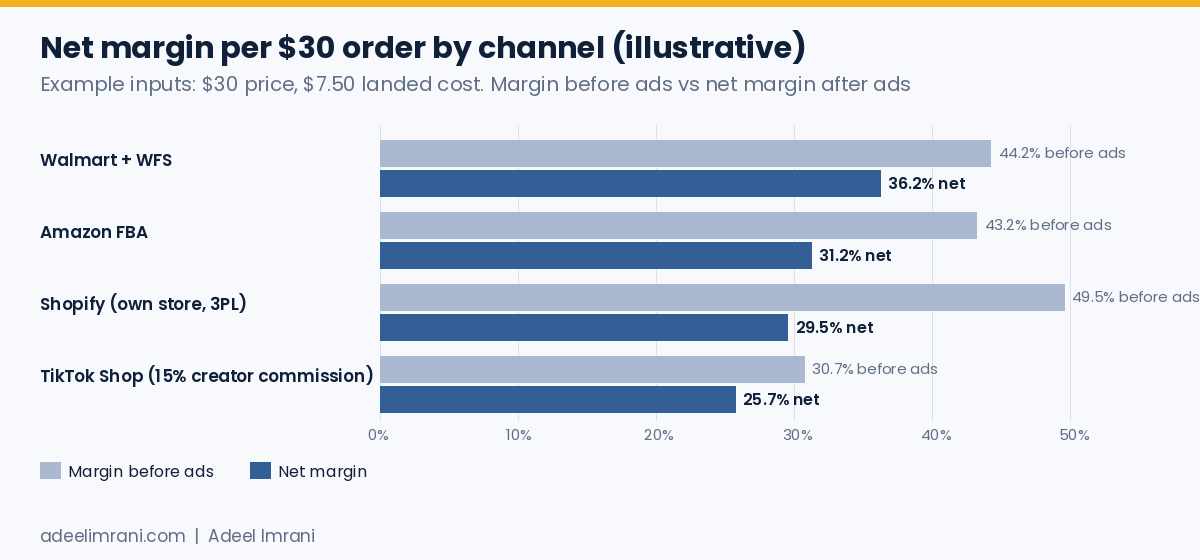
Two things matter more than the ranking. First, Shopify has the highest margin before ads (49.5%) but needs the most paid traffic, because nobody finds your store unless you pay. Second, TikTok Shop has the lowest margin before ads (30.7%) because the creator commission is a real cost of the sale, even though TikTok's own referral fee is only 6%.
Change the ad assumption and the order changes. If the Shopify ad cost in this example drops from 20% to 12% of price, Shopify's net rises by $2.40 per order to $11.25 (37.5%) and it moves to first place. The honest takeaway: your ranking depends on what it costs you to win an order on each channel.
What is a good TikTok Shop profit margin?
There is no official TikTok figure for a "good" margin. What you can control is the arithmetic. For each order, start from price and subtract product cost, the referral fee, the creator commission, free samples, ads, returns and fulfillment. What is left, divided by price, is your net margin per order before overhead.
In the worked example below, a $30 beauty product nets $7.70 per order on TikTok Shop, a 25.7% margin, with a 15% creator commission. Raise the commission to 25% and the margin falls to 15.7%. That one input moves TikTok Shop profit margin more than any fee TikTok publishes, so set commissions from your margin, not from what other shops pay.
Third-party estimates give a rough frame, but they are vendor estimates, not TikTok data: Margn suggests aiming for 20% to 30% net after all costs, and FastMoss puts its estimated industry-wide average at 18.4%. Treat your own per-order margin, after overhead, as the number that matters, and compare it with what the same product keeps on Amazon using the calculator below. For Amazon benchmarks, see what a good profit margin on Amazon is for beauty brands.
What fees does each channel charge in 2026?
Published fees for a beauty product, checked October 27, 2026:
Amazon: referral fee, FBA fulfillment and a surcharge
- Referral fee: for Beauty, Health and Personal Care, 8% when the total sales price is $10.00 or less and 15% when it is above $10.00, with a $0.30 minimum. The total price includes shipping and gift-wrap charges (Amazon pricing page).
- Selling plan: Professional is $39.99 per month.
- FBA fulfillment: per unit, by size, weight and price band. Amazon said 2026 FBA fees would rise about $0.08 per unit on average. A third-party rate card shows $3.54 (non-peak) for a 6-8 oz small-standard unit priced $10 to $50. Confirm your own ASIN in Amazon's Revenue Calculator.
- Surcharge and peak season: a 3.5% fuel and logistics surcharge applies to FBA fulfillment fees from April 17, 2026, and peak fees (October 15, 2026 to January 14, 2027) average $0.32 more per unit. The example uses non-peak fees plus the surcharge, so peak-season orders earn slightly less.
Walmart Marketplace: the same referral rate, a different fulfillment bill
- Referral fee: Beauty, Health and Personal Care is 8% at $10 or less and 15% above $10, the same structure as Amazon (Walmart Marketplace Learn).
- Monthly fee: Walmart's pricing page says zero monthly or setup fees.
- WFS fulfillment: $3.45 per unit up to 1 lb shipping weight, plus $0.50 if the item is or contains a chemical or aerosol and $1 if it is priced under $10.
TikTok Shop: a low referral fee plus creator costs
- Referral fee: TikTok's category table lists 6% for Beauty and Personal Care subcategories, including skincare, makeup, haircare, fragrance and nail care. The base is the customer payment plus platform discount minus tax, and the category table says it includes customer-paid shipping.
- Refunds: TikTok refunds the referral fee minus an administration fee of 20% of it, capped at $5 per SKU since May 15, 2025.
- Affiliate commission: you set it from 1% to 80%, and it is paid on top of the referral fee.
- Settlement: payment comes after delivery if no refund or return request is open.
- Monthly fee: TikTok's referral-fee articles list no subscription fee. Confirm in Seller Center.
Shopify: subscription plus card processing
- Plan: Basic is $29 per month billed yearly or $39 billed monthly.
- Card rates (Basic, online): 2.9% + 30¢ standard and 3.5% + 30¢ premium.
How do you calculate net margin per order?
Use one formula for every channel:
- Start with the price the customer pays, minus tax.
- Subtract landed cost: what the unit cost delivered, including freight, duty and prep.
- Subtract percentage costs: referral fee, payment processing, creator commission, advertising, samples and a returns allowance, each as a percentage of price.
- Subtract fixed per-order costs: fulfillment and storage, the fixed 30¢ card fee on Shopify, and the monthly plan fee divided by orders per month.
- Divide what is left by the price to get net margin. Add advertising back to get margin before ads, which is the most you could spend on ads for that order and still break even.
That last number is the bridge to bidding decisions. If the margin before ads is 43.2% on Amazon, an ad-driven order stops making money once ad cost passes 43.2% of the order price, and your target should sit well below that. The breakeven ACoS, target ACoS and TACoS guide shows how to turn it into bids. As a reference point, the Hair Care case study reports a final ACoS of 19.78%. That would sit comfortably under a 43.2% breakeven, but on a thinner product the same ACoS could lose money.
Worked example: one $30 beauty product on four channels
Referral fees and plan fees are published rates. Everything else is an example assumption to replace with your own statements:
- Common: $30 price, $7.50 landed cost, 3% returns allowance, 500 orders per month.
- Amazon: 15% referral, 12% ads, $4.06 fulfillment and storage, $39.99 plan.
- Walmart: 15% referral, 8% ads, $3.85 fulfillment and storage, no plan fee.
- TikTok Shop: 6% referral, 15% creator commission, 5% ads, 2% samples, $5.50 fulfillment and postage.
- Shopify: 2.9% + $0.30 card fee, 20% ads, $5.50 fulfillment and postage, $39 plan.
Where the fulfillment numbers come from: Amazon's $4.06 is the $3.54 rate-card fee plus the 3.5% surcharge ($3.66) plus a $0.40 allowance for storage and inbound. Walmart's $3.85 is the $3.45 WFS fee plus the same $0.40 allowance. TikTok and Shopify use an example $5.50 for pick, pack and postage through a 3PL, which you should replace with your own quote.
Amazon FBA, step by step
- $30.00 price minus $7.50 landed cost = $22.50.
- Referral 15% = $4.50. Ads 12% = $3.60. Returns 3% = $0.90.
- Fulfillment and storage = $4.06. Plan fee $39.99 ÷ 500 orders = $0.08.
- Deductions: $4.50 + $3.60 + $0.90 + $4.06 + $0.08 = $13.14.
- Net = $22.50 − $13.14 = $9.36, or 31.2% of price.
TikTok Shop, step by step
- $30.00 − $7.50 = $22.50.
- Referral 6% = $1.80. Creator commission 15% = $4.50. Ads 5% = $1.50. Samples 2% = $0.60. Returns 3% = $0.90.
- Fulfillment and postage = $5.50.
- Deductions: $1.80 + $4.50 + $1.50 + $0.60 + $0.90 + $5.50 = $14.80.
- Net = $22.50 − $14.80 = $7.70, or 25.7% of price.
Walmart follows the same steps: deductions of $4.50 + $2.40 + $0.90 + $3.85 = $11.65, so net is $10.85 (36.2%). Shopify: $0.87 + $6.00 + $0.90 + $0.30 + $5.50 + $0.08 = $13.65 (rounded), so net is $8.85 (29.5%).
Sensitivity: what moves the answer most
- TikTok creator commission 15% to 25%: net falls $3.00, from $7.70 to $4.70 (15.7%).
- TikTok referral fee 6% to 8%: net falls $0.60, from $7.70 to $7.10 (23.7%). See the unconfirmed-rate section below.
- Shopify ads 20% to 12%: net rises $2.40, from $8.85 to $11.25 (37.5%).
Net margin per order calculator (editable)
Enter your own price, landed cost and channel costs; results update as you type. Defaults are the example above, and they still show if JavaScript is off.
Four-channel net margin per order calculator
What do headline fees leave out for beauty brands?
Creator commissions and free samples
On TikTok Shop the commission is a cost you set, anywhere from 1% to 80%, so the same product can carry very different economics depending on how you recruit creators. Samples are a second cost: every unit you send out has landed cost and no revenue.
Returns of opened cosmetics
A returned lipstick, serum or nail polish is often not resellable, so a return can cost you the product plus processing. Walmart's WFS return processing starts at $4.70 per unit up to 1 lb, and TikTok keeps part of the referral fee on a refund. Track opened-and-unsellable returns by channel instead of assuming the same 3% everywhere.
Ads and cash timing
Sponsored ads, TikTok Shop ads and Shopify's paid traffic all sit outside the referral fee, which is why margin before ads is the number to compare first. Cash timing matters too: TikTok settles after delivery and only if no refund or return request is open, so compare real payout schedules across channels.
Product constraints that change the channel
Shelf life and dangerous goods can decide whether a SKU belongs in a warehouse program at all. Amazon applies expiration-date rules to beauty inventory (see the FBA expiration date guide). Aerosols and flammable products such as nail polish may be treated as hazardous (see the nail polish hazmat guide), and WFS adds $0.50 per standard item that is or contains a chemical or aerosol. Such a SKU may be easier to ship yourself or from a 3PL.
Is TikTok Shop's referral fee 6% or 8% in 2026?
TikTok's official fee table, checked October 27, 2026, lists 6% for Beauty and Personal Care. Some third-party trade reports say most non-food categories moved to 8% on August 4, 2026. I could not find TikTok confirming that on its official pages, so treat it as unconfirmed. The impact is easy to bound: on a $30 order, 8% costs $0.60 more than 6%. Check the referral fee line on your own settlement statement, and re-run the calculator with the rate you actually pay.
Which channel should a beauty brand use for which job?
Rules of thumb from the economics above, not platform rules:
| Situation | Channel that usually fits | Why |
|---|---|---|
| Hero SKU with steady search demand | Amazon, then Walmart | Demand already exists, so ads convert intent. |
| New SKU or demonstration-led product | TikTok Shop | Creators can demonstrate texture and results. |
| Hazmat or short shelf-life SKU | Own store or 3PL, or the channel with the cleanest rules | Network rules and fees can erase margin. |
| Repeat-purchase or bundle products | Shopify | You own customer data and bundles. |
| Low-margin SKU (under about 35% before ads) | Few channels, or reprice first | Commissions or ads can push net margin toward zero. |
How do you run this analysis on your own SKUs?
- Pick your top five SKUs by revenue, plus one hazmat or short-shelf-life item.
- Pull real fees from each platform's statements, not the headline rate.
- Enter price, landed cost, fulfillment and ad spend per channel in the calculator.
- Rank by margin before ads, then by net margin, and re-check monthly because fees change.
For the bigger picture, the Amazon Profit Paradox post explains why revenue growth can hide shrinking profit, and the $100 profit waterfall shows the full Amazon cost stack line by line.
Key takeaways
- Compare channels on net profit per order, not on referral fee.
- In this example, margin before ads is highest on Shopify (49.5%) and lowest on TikTok Shop (30.7%), but net margin depends on what each order costs to win.
- TikTok's 6% fee is published, but a 15% creator commission and samples are larger costs. An 8% fee is unconfirmed.
- Amazon and Walmart share the same 8% and 15% beauty referral structure; fulfillment and ads are where they differ.
- Every "example" number here is an assumption; replace it with your own statements.
Frequently asked questions
Is TikTok Shop cheaper than Amazon?
On referral fee alone, yes: TikTok Shop's published beauty rate is 6% against Amazon's 15% above $10. But creator commissions (1% to 80%, set by you), samples and fulfillment can erase the gap. In the $30 example, TikTok Shop with a 15% creator commission nets 25.7%, versus 31.2% on Amazon.
What is TikTok Shop's referral fee for beauty products?
TikTok's published table lists 6% for Beauty and Personal Care, including skincare, makeup, haircare, fragrance and nail care, calculated on customer payment plus platform discount minus tax. Some third-party reports claim an increase to 8%, but TikTok has not confirmed it publicly. Verify the rate on your own settlement statement.
Does TikTok Shop have a monthly fee?
TikTok's referral-fee articles list no monthly subscription fee, only the referral fee plus the costs you choose, such as affiliate commission, ads and shipping. Confirm in Seller Center. By comparison, Amazon Professional is $39.99 per month, Walmart lists zero monthly fees, and Shopify Basic is $29 per month billed yearly or $39 monthly.
Are Walmart Marketplace fees the same as Amazon's for beauty?
The referral fee structure matches: 8% when the total sales price is $10 or less and 15% above $10. Other costs differ. Walmart lists no monthly fee, while Amazon Professional costs $39.99 per month. Fulfillment fees, return processing, storage and ad costs differ by program, so compare your own SKU in each calculator.
How much commission should I give TikTok creators?
TikTok allows 1% to 80%, and there is no single right number. Start from your margin before creator costs and decide how much to share. In the example, raising the commission from 15% to 25% cuts net profit per order from $7.70 to $4.70 (25.7% to 15.7% margin).
Is TikTok Shop profitable for beauty brands?
It can be, if your margin before creator commission, samples and returns is high enough. The example product keeps 25.7% after a 15% commission but only 15.7% at 25%. Test a few SKUs, compare settlement statements with your model, and scale only those that stay positive.
Is selling on Shopify cheaper than selling on Amazon?
Shopify has no referral fee, only 2.9% + 30¢ on standard cards plus a plan fee, so its margin before ads is highest in the example (49.5%). But you pay for all traffic, and the example assumes 20% ad cost versus 12% on Amazon. Which is cheaper depends on your cost to acquire an order.
What is a good profit margin on TikTok Shop?
TikTok publishes no target. Vendor estimates suggest aiming for roughly 20% to 30% net after all costs, but treat that as a frame, not data. In this guide's $30 beauty example, TikTok Shop nets 25.7% per order with a 15% creator commission and 15.7% at 25%, before overhead.
How do you calculate TikTok Shop profit margin?
Take the price and subtract product cost, the TikTok referral fee, creator commission, free samples, ad spend, returns and fulfillment, then divide by price. Example: $30 minus $7.50 product cost and $14.80 of other costs leaves $7.70, a 25.7% net margin per order before overhead.
Where to go next
If you want this model built on your real statements, I do it as part of a profit audit. See about me, browse the case studies, or book a free Profit Clarity Audit.
I also build software for Amazon sellers and brands, called BidVentor. Disclosure: I'm the founder of BidVentor.
Sources
All fees checked October 27, 2026.
- Amazon: Sell on Amazon pricing and referral fees
- Amazon Selling Partners: 2026 US referral and FBA fee update
- CNBC: Amazon 3.5% fuel and logistics surcharge for sellers
- Supply Chain Dive: Amazon 2026 holiday fulfillment fees
- Walmart Marketplace Learn: referral fee schedule
- Walmart Marketplace: pricing and WFS fees
- TikTok Shop Seller University: referral fees by category
- TikTok Shop Seller University: referral fee updates, refunds and settlement
- TikTok Shop Seller University: setting up affiliate collaborations
- Goat Consulting: 2026 Amazon FBA rate card (third party)
- Marketplace Beta: TikTok Shop beauty fee note on the unconfirmed 8% rate (third party)
- Shopify: pricing
- Margn: TikTok Shop profit margins by category (vendor estimate, updated Sep 2026)
- FastMoss: TikTok Shop profitability, top 10 US sellers (vendor estimate, Jun 2026)